Internal Network and Dual-Asset Settlement
Download PDFSATI operates three assets of different natures separately.
| Asset | Network | Transferability | Role |
|---|---|---|---|
| Public SATI Token | Public chain (to be selected) | Transferable | Ad deposits, external liquidity, ecosystem settlement |
| Native SATI Coin | SATI internal protocol network | Restricted | User rewards, internal service payments |
| SATI Data Credential | SATI internal protocol network | Non-transferable | Proof of data attributes, eligibility and consent status |
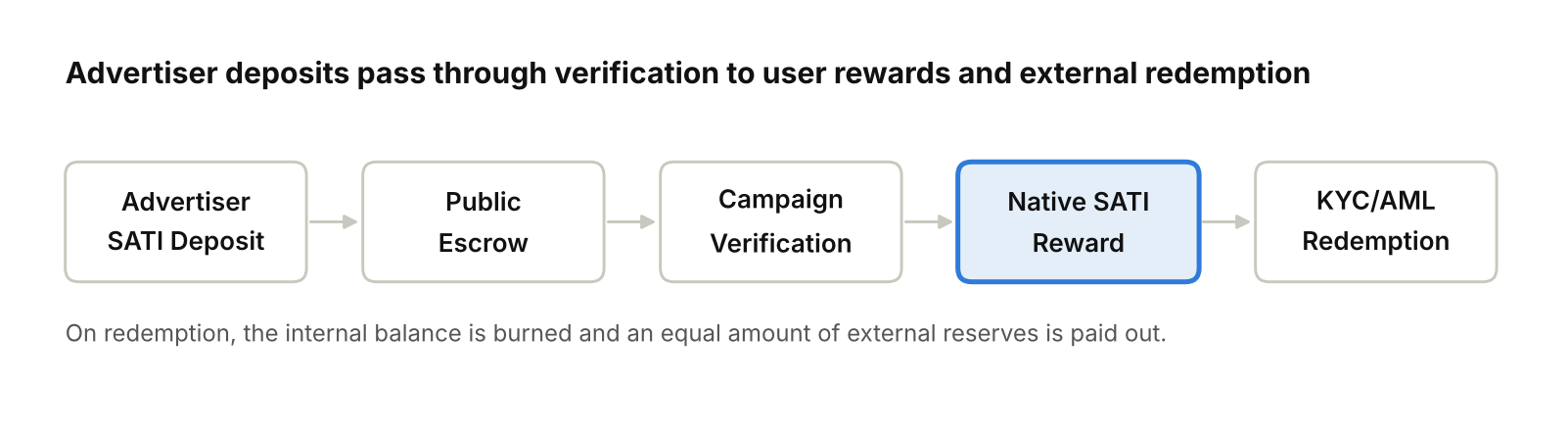
Restrictions on the Internal Coin #
- Peer-to-peer transfers between users are prohibited.
- Direct withdrawals to external wallets are prohibited.
- The coin may be used only within approved services and smart contracts in the SATI ecosystem.
- Only the user who earned the coin may apply to redeem it for external SATI tokens.
- Following KYC/AML review, the internal balance is burned and an equal amount of external reserves is paid out.
- Each KYC-verified account is linked to a SATI app wallet on a 1:1 basis by policy.
KYC is only one element of exit control and does not replace AML as a whole. Advertiser KYB, sanctions and PEP screening, transaction monitoring, anomaly detection, source-of-funds verification, limits and delayed payouts, and, where necessary, integration with Travel Rule and suspicious transaction reporting frameworks are reviewed on a jurisdiction-by-jurisdiction basis.
Gasless Smart Accounts #
Users should be able to use SATI without prior knowledge of gas fees, networks, bridges or private key management. The built-in smart wallet uses session keys, spending limits, contract allowlists, recovery policies and risk-based step-up authentication. Gas is paid on the user's behalf by a Paymaster or system account operated by SATI Labs or the service provider.
For integration with public chains, SATI draws on ERC-4337 smart accounts and the batching, sponsorship and permission-scoping concepts of EIP-7702. The initial internal network provides the same user experience and policy constraints on its own execution layer; the specific account implementation and chain selection will not be finalized until security audits are completed.